
For years, provider network management software was built around a relatively simple assumption: maintain a provider database, update it periodically, and publish an accurate directory.
That assumption no longer holds.
Today, provider networks change continuously. Physicians change practice locations, join and leave organizations, stop accepting new patients, retire, or alter their participation across Medicare, Medicaid, commercial, and value-based contracts. Every change must flow through roster management, contracting, credentialing, provider directories, member-facing search tools, and regulatory reporting. For most health plans, that process still depends on fragmented data sources and manual reconciliation.
At the same time, the expectations placed on network operations have fundamentally changed. CMS has strengthened oversight of provider directory accuracy, state regulators are increasing enforcement, and inaccurate provider data is no longer viewed as a minor administrative issue. It affects whether members can find care, whether providers receive unnecessary outreach, whether network adequacy analyses reflect reality, and whether health plans can confidently execute value-based contracting strategies. Recent investigations into "ghost networks" have further exposed how quickly inaccurate provider data can become a compliance, operational, and reputational risk.
These pressures are forcing health plans to rethink what they expect from provider network management software. A system designed primarily to store provider records is no longer sufficient. Modern platforms are increasingly expected to validate provider information continuously, automate data ingestion from disparate sources, support increasingly sophisticated contracting models, integrate across the enterprise, and provide the operational intelligence needed to manage networks proactively rather than reactively.
The challenge is that almost every vendor claims to deliver these capabilities. AI-powered automation, intelligent workflows, network analytics, and end-to-end provider management have become standard marketing language, making it difficult to distinguish genuine capability from feature parity.
This guide provides a practical framework for evaluating provider network management software based on the capabilities that matter most to health plans today. Rather than comparing feature lists alone, it explores how to assess a platform's ability to improve provider directory accuracy, support value-based contracting, fit within broader modernization initiatives, and deliver measurable operational value over the long term.
Why Provider Network Management Software Has Changed
Ten years ago, provider network management software did one job well enough: hold a database of providers, accept roster files, publish a directory, and remind someone when a credential was about to lapse. That was a reasonable scope when networks moved slowly, when a directory update happening within thirty days was considered timely, and when nobody outside the plan looked closely at what the directory actually said.
None of those conditions hold anymore. A Senate Finance Committee secret shopper study called 120 listed mental health providers across 12 Medicare Advantage plans in six states and found a third were unreachable, wrong numbers, or never called back. Around the same period, research out of the University of Maryland, tracked 432,146 providers advertised as in-network across 3,659 Medicare Advantage plans nationwide and found close to 40 percent were likely ghosts, meaning they'd billed fewer than 11 Medicare Advantage claims in a full year despite appearing available. Those aren't edge cases. That's the baseline condition of the average directory, uncovered by anyone who bothered to check.
What's changed is who's checking. CMS's contract year 2026 final rule, published in the Federal Register, now requires Medicare Advantage organizations to attest at least annually that their submitted directory data is accurate, and that same data now populates the Medicare Plan Finder tool beneficiaries use to shop plans directly. State attorneys general have followed the same path; New York's 2023 report on mental health directories pushed several states toward independent audit requirements rather than the honor system plans previously operated under. None of this is enforcement theater. It's a shift from a category nobody scrutinized to one where the underlying data has a legal signature attached to it once a year.
How Provider Directory Errors Happen (And What Software Should Prevent)
Most evaluation conversations start with 'how accurate is your data,' which is the wrong first question because it invites a marketing number. The better starting point is understanding the mechanics of how directories go wrong in the first place, because that determines which architecture actually fixes it.
A provider record degrades through at least four distinct failure modes, and most legacy systems only catch one or two of them. A provider retires or relocates, and nobody tells the plan, which self-attestation and periodic outreach eventually catch, slowly. A provider is listed under a group NPI that technically covers them, but they personally never see that plan's patients, which outreach calls to the front desk often miss entirely because the front desk doesn't know either. A record gets duplicated across two credentialing feeds with slightly different addresses, and the system treats them as two providers instead of flagging the conflict. And a provider closes their panel to new patients without formally terminating the contract, which shows up nowhere until a member tries to book and gets turned away.
Claims-based verification catches the first and fourth pattern well, since billing activity is a hard signal that outreach calls can't fake. It's weak on the second and third, which is why the strongest platforms triangulate claims data against NPPES, state licensure boards, and health system credentialing feeds rather than leaning on any single source. Ask a vendor to walk through which of these four failure modes their system actually catches automatically, and which still require a human to notice something looks off. Most vendors have a good answer for one or two of the four. Very few have a good answer for all of them, and that gap is usually where the real differentiation sits.
How to Evaluate Interoperability and FHIR Support
CMS now requires Medicare Advantage organizations and many Medicaid and CHIP plans to publish provider directory data through a public-facing FHIR-based API. Most vendors implement this using the HL7 Da Vinci PDex Plan-Net Implementation Guide, which has become the de facto interoperability standard for payer provider directories. This is a genuine standard with defined resources for organizations, locations, practitioners, and network affiliations, and it's worth checking that a vendor's platform generates this natively rather than bolting on a compliance layer at the end of a project. But it's worth being clear-eyed about what FHIR compliance a plan buys: it's a query-only, read-facing API. It publishes what the system already believes to be true. It does nothing to improve the accuracy of what gets published. A plan can be perfectly FHIR-compliant and still be broadcasting a ghost network through a beautifully standards-compliant interface. Compliance and accuracy are two separate engineering problems, and a vendor demo that conflates them is worth pushing back on.
The integration question that predicts implementation pain is narrower: does the platform have a documented, versioned connector to the specific claims adjudication system, credentialing platform, and member portal a plan already runs, with a reference client using that exact combination. A generic answer about 'robust API support' is not a substitute for that specific answer, and the gap between the two is usually where six-month implementation estimates quietly become fourteen-month ones.
Value-based contracting exposes a different kind of software gap
Directory accuracy is a compliance story. Value-based contracting readiness is a revenue story, and it exposes a completely different weakness in most legacy systems: the provider record and the contract record have never lived in the same place.
The stakes here keep rising. The Health Care Payment Learning and Action Network measured the share of U.S. healthcare payments flowing through alternative payment models with downside financial risk at 28.5 percent in 2024, up from 24.5 percent two years earlier, and a Fierce Healthcare survey of hospital and health system C-suites found more than three-quarters now plan to expand value-based participation over the next two years. Plans on the other side of those contracts need software that can answer a question most network management systems were never built to answer which specific providers, in which specific specialties and counties, are actually driving the quality and cost outcomes a given arrangement is measured against, and how does that overlap with where the network currently has gaps or redundancy.
This is where the concept of attribution becomes the real test of a platform, not a footnote. Attribution, in a value-based arrangement, is the logic that assigns a member to a specific provider or group for measurement purposes, and it depends entirely on having clean, current, deduplicated provider data feeding into it. A system with fragmented or duplicated provider records will produce attribution that contracting teams don't trust, which means the quality and cost data built on top of it becomes something people argue about in meetings rather than something they act on. Ask a vendor directly how their platform handles attribution logic and ask for a specific example of a plan that used it to renegotiate a contract term. If the honest answer is that attribution happens in a separate analytics tool fed by a manual export, that's a real limitation worth pricing into the decision, not a small gap.

How to Evaluate AI Capabilities in Provider Network Management Software
Healthcare AI adoption is real and it's accelerating fast. A Forbes analysis of Menlo Ventures and Morning Consult survey data found that 22 percent of healthcare organizations had implemented domain-specific AI tools by late 2025, a sevenfold jump over 2024 and a tenfold jump over 2023. Payers still trail providers, at 14 percent adoption versus 27 percent for health systems, which tracks with what network operations teams describe anecdotally: the provider-facing side of healthcare has moved faster on AI than the payer-facing side, and network management is one of the areas where payers are just beginning to catch up.
In this specific category, the applications that hold up under scrutiny are narrower than the marketing suggests. Document extraction from messy roster files genuinely works and saves real hours, because optical character recognition and structured extraction are mature, well-understood problems. Discrepancy flagging across multiple data sources, essentially automating the triangulation described above, is a legitimate and valuable use of pattern matching. Predictive staleness scoring, which flags which provider records are statistically likely to have gone out of date based on time since last verification and specialty-specific churn patterns, is newer but defensible.
What's less defensible is any claim that AI is independently verifying provider availability without a human in the loop, or that it can resolve conflicting data sources with confidence rather than flagging them for review. The honest vendors will tell you where their model is uncertain and route that to a person. The ones to be skeptical of are the ones whose system always seems to have an answer. Ask specifically what percentage of records the AI flags as needing human review versus resolves automatically and ask to see what that review queue actually looks like day to day, not in a slide.
Why Audit Trails and Compliance Matter
Under the annual attestation requirement in CMS's 2026 final rule, a health plan executive is putting their name behind the accuracy of directory data submitted to CMS. That attestation is only defensible if every change to a provider record, whether made by a staff member, an automated process, or an AI-assisted workflow, is timestamped and attributable to a specific source. This sounds like a compliance checkbox until an OIG inquiry or a state audit asks a plan to reconstruct why a specific provider was listed as in-network on a specific date six months ago. A platform without a granular, exportable audit trail turns that into a research project. A platform with one turns it into a five-minute query. Test this directly during a demo: ask to see the full change history on a single provider record, not a summary.
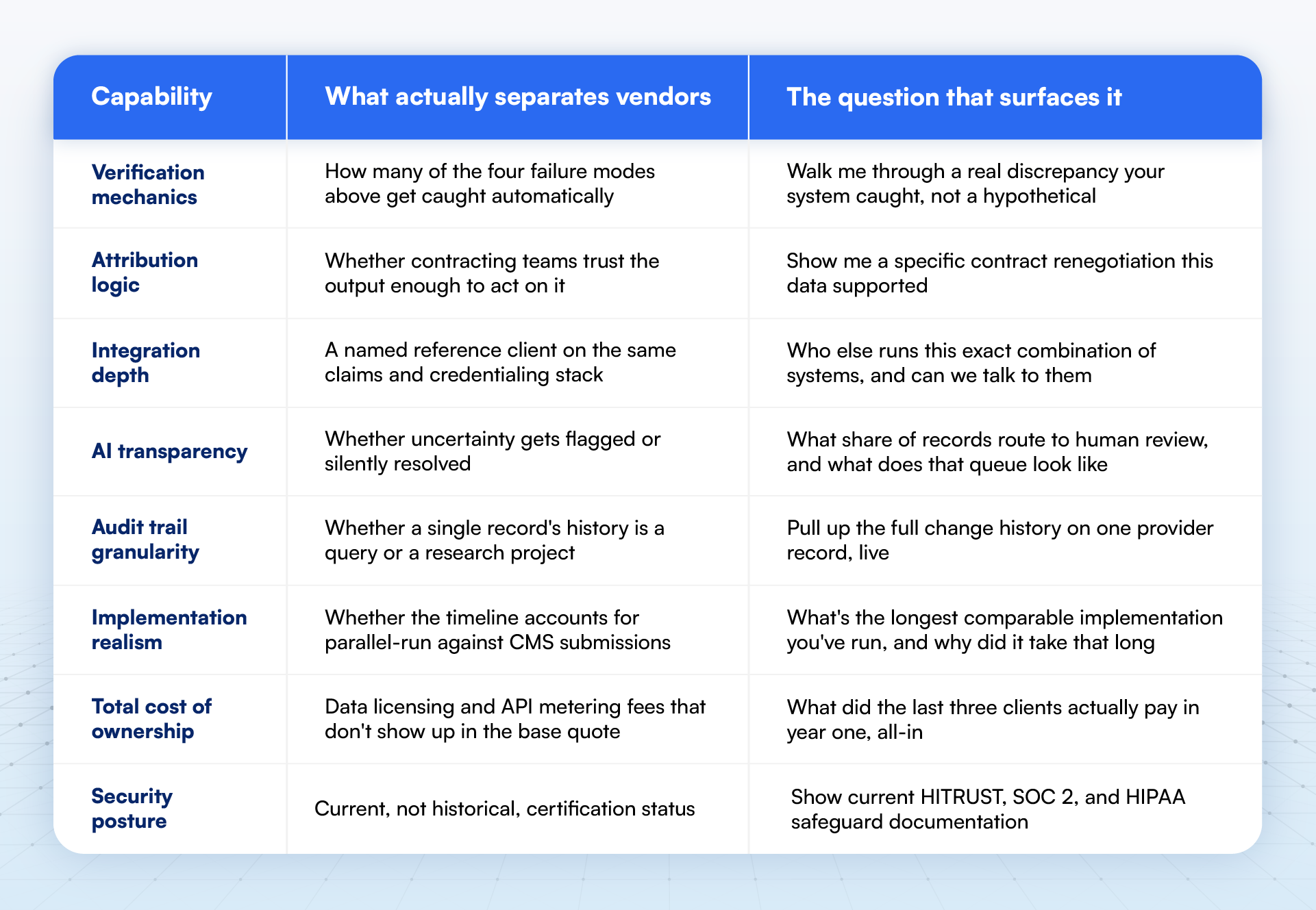
Provider Network Management Software Evaluation Checklist
By the time an evaluation narrows to two or three finalists, every vendor looks similar on a feature matrix. What separates them shows up when the same eight categories get scored by the people who will actually use the system, not just by procurement.
Common Mistakes When Evaluating Provider Network Management Software
The most common failure isn't picking the wrong vendor. It's structuring the evaluation in a way that never tests the things that matter the most. A few patterns show up often enough to be worth naming directly.
- Scoring an RFP response instead of testing the system against a real, messy roster file the plan already has sitting in a shared drive somewhere
- Assuming the new platform will clean up data quality problems inherited from the old one, when in practice bad data migrates just as faithfully as good data does
- Letting IT and procurement run the evaluation without network operations staff in the room, so workflow friction only surfaces after go-live
- Buying a strong directory accuracy tool while leaving contract and quality data in separate systems, which just relocates the fragmentation problem rather than solving it
- Accepting an AI capability on the strength of the demo rather than asking for a specific, verifiable outcome from an existing client
- Comparing base license quotes without asking what data fees, API call volume, and internal staff hours added up to in a comparable client's first year
How HiLabs Supports Modern Provider Network Management
HiLabs addresses these challenges through MCheck® NetworkIQ, a provider network management platform designed to help health plans improve directory accuracy, maintain network adequacy, and modernize provider network operations. Instead of managing provider data, compliance, and contracting in separate workflows, NetworkIQ brings them together on a single, continuously reconciled provider data foundation.
The platform uses AI to identify provider data discrepancies, eliminate ghost network issues, and continuously assess network adequacy against CMS and state requirements. Built-in compliance rules and audit-ready reporting help plans generate CMS HSD submissions and other regulatory reports with greater confidence, while real-time "what-if" scenario modeling allows network teams to evaluate the impact of provider changes before they affect compliance or member access.
On the contracting side, companion capabilities use the same trusted provider data to manage provider contracts and pricing, giving network and contracting teams a single source of truth instead of reconciling information
NetworkIQ was recognized in Gartner's 2025 Market Guide for U.S. Healthcare Payers' Provider Network Management Applications, and it's been adopted by a leading national behavioral health plan specifically to move from a reactive, point-in-time view of network adequacy to continuous, intelligence-driven oversight.
Like every platform, it should be evaluated against the framework outlined in this guide. The goal is to determine whether its capabilities align with your organization's priorities for compliance, provider access, contracting, and long-term network modernization.
The Honest Bottom Line
Provider network management software used to be judged on how complete its database was. It's now judged on how fast it can tell the truth about a network that changes constantly, defend that truth to a regulator, and hand contracting teams' data they're willing to negotiate a payment model against. Those are three different engineering problems wearing one product category's name, and most vendors are genuinely strong at one of them. Very few are strong at all three, which is exactly why the evaluation questions above matter more than the feature list.
